
Wildflowers for wet areas
- Andy Northcott2

- Apr 13, 2016
- 5 min read
Updated: May 28
Wildflowers for wet areas
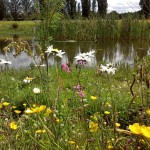
Benefits of Wildflowers for wet areas
In February we wrote an article about growing wildflowers on clay. Clay soils often get very water logged in winter but what about areas prone to regular winter flooding that remain under water for long periods. Flood meadows have always played a part in flood alleviation and there are many benefits of growing specialist wildflowers for wet areas. As a scheme at Longford near Gloucester demonstrates, the restoration and creation of new wildflower water meadows can naturally enhance flood defense schemes as well as providing a valuable asset for the community and a haven for wildlife.
Creation of Plock Court Wetland Area
In spring 2011 we were asked to supply a wildflower mix for an area, just north of Gloucester, on the edge of the River Severn’s flood plain. The area is just a few hundred metres from my own home and working with Gloucestershire City Council, I surveyed the area in early spring 2011. The site was previously used for sporting activities and prone to very regular winter flooding. The Northern half of the site, an area of just under 1 acre was the wettest and it was decided that this area would be sown with a special mix of wildflowers for wet soils. The remaining area, similar in size, was not as prone to flooding, so here we decided to use a clay wildflower mix that would tolerate slightly drier conditions in the summer months. Additionally it was decided to sow a special tussocky mix at the edge of the scrapes. This would provide taller vegetation and more cover for wildlife.

Construction of scrapes about to start
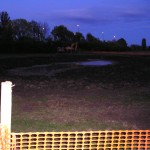
Spring 2011
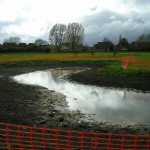
Wildlife scrape shortly after construction showing extent of water table.
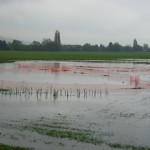
Extent of floodwater after heavy rainfall
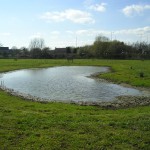
View of main wildlife scrape shortly after construction and sowing
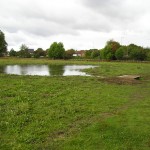
Wetland area after construction of board walk and initial germination of wildflower mix
In the summer of 2011 the existing grasses were removed and the whole site prepared for sowing. At the same time, 2 wildlife scrapes were excavated and connected to a nearby ditch by means of a shallow balancing channel. Surplus water would then be absorbed by the planned wetland meadow, acting as a large soakaway and reducing flood risk. When the rainfall subsides excess water in the scrapes could drain gently back into the ditch.
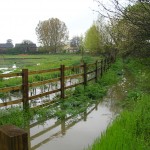
Drainage ditch adjacent to Wildlife scrapes.
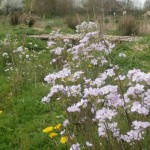
Cuckooflower in the channel joining the 2 wildlife pools in April 2015
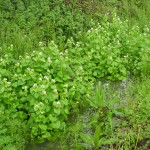
Hedge Garlic growing in the flooded ditch running parallel with Tewksbury Road
The area was sown in October 2011 and fortunately the winter weather was kind, allowing an excellent germination. Most unusually, several perennial wildflowers were already in flower the following summer including Ox-eye daisies and Ragged Robin. The area had previously held a good stands of Cuckoo flowers in the surrounding ditches and these were quick to spread into the newly sown meadow grass. Over the winter the area was planted with new native trees including oak, birch and alder. The whole area was enclosed with an attractive post and rail fence. Some additional wildflower plugs were planted to provide specialist wildflowers for wet areas around the pools. At around this time, the wetland area benefited from long term protection, when the playing fields were awarded “field in trust” status to mark the Queen’s Diamond Jubilee year.
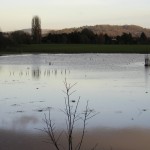
November 2012 floodwater
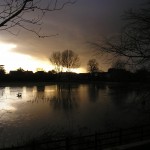
Winter Floodwater at dusk
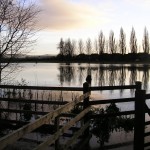
View of floodwater from northern entrance
The winter of 2012 was unusually wet with the whole area under water for many weeks in early spring. The sward recovered from the inundation of floodwater extremely well and by the summer of 2013 the whole area was in full flower offering a spectacular sight in the summer sunshine. Ragged Robin, Ox-eye daisy and Meadow Buttercup dominated the display.
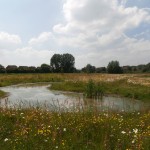
View of wildlife scrape in June 2013
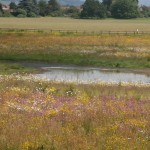
View from Tewkesbury Road June 2013
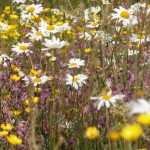
Ox-eye daisies, Ragged Robin and Meadow Buttercup in June 2013
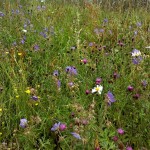
Flowering in summer 2016 showing developing diversity with plants such as Meadow Cranesbill and Black Knapweed
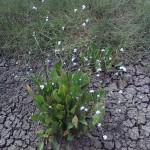
By 2015 species such as Water Plantain have established by natural regeneration at the edges of the wildlife scrapes
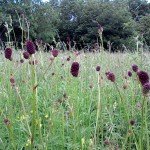
Great Burnet a species typical of low lying Gloucestershire meadows appeared near the scrapes in 2015. An encouraging sign !
In 2014 and 2015 the Ox-eye daisy and Ragged Robin became less dominent but were replaced by other slower growing species supplied within the original seed mixtures such as Common Sorrel, Meadow Cranesbill, Black Knapweed, Purple loosestrife and Hedge Bedstraw. Some of these can be seen in the short video below.
At the bottom of this article you can find a more comprehensive list of some of the wildflowers that can be seen at Plock Court Wildlife area in spring and summer. Many of these species make great wildflowers for wet areas and we can supply many of them either as plug plants, bulbs or wildflower seed packets.
The Plock Court wetland area has become a haven for wildlife. The scrapes attracted a visiting Green Sandpiper within the first 12 months of construction and also a Little Egret and Snipe. In spring the muddy edges of the pools provide vital nest building material for a nearby colony of House Martins at Plock Court. The surrounding trees and newly planted shrubs are already attracting warblers in summer such as Chiffchaff, Whitethroats, Blackcaps, Sedge and Willow warbler. Now that the vegetation has become established, Dragonflies and Damselflies have become a common sight in summer around the pools.
As time passes it is hoped that more wildflower species will appear in the wetland area, some as a result of the initial sowings and some through natural regeneration. Eventually the whole meadow could resemble how it would have looked in the past. It is likely that vegetation will eventually develop around the scrapes, creating habitats similar to those at the nearby disused brick pits such as Walham ponds and Sandhurst Nature reserve.
Ordering Wildflowers for wet areas
All wildflower mixtures, plug plants and bulbs for the Plock Court Wetland area were supplied by Yellow Flag Wildflowers and can be ordered through our website.
Visiting Plock Court Wildlife Area:
There is a small car park just to the left of the entrance to the sports parks. From here, the Plock Court Wetland area is about a 2 minute walk. You will find several benches and a picnic table. The best months to find wildflowers are from June to August. It is politely requested that dogs are kept on leads within the sensitive area inside the railed fence.
Plock Court Playing Field,
Plock Court,
Gloucester,
Gloucestershire,
GL2 9DW
Wildflowers to look for at Plock Court Wetland area :
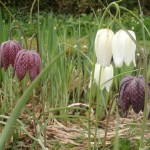
Snake’s head fritillary. A few bulbs have been planted around the scrapes and flower in spring
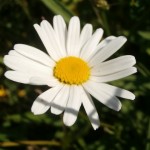
Look for Ox-eye daisies in June.
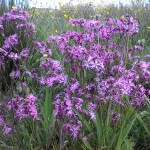
Ragged Robin. This classic wetland wildflower grows well at Plock Court.
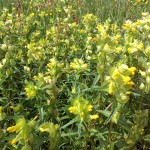
Yellow Rattle is useful in reducing grass growth and maintenance. It is slowly spreading within the area.
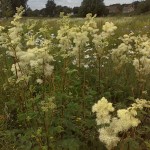
Meadow-sweet flowers in summer near the boardwalk between the 2 wildlife pools.
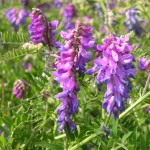
Look for Tufted Vetch around the edges of the smallest pool
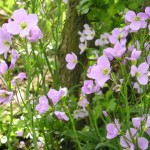
Cuckooflower grows well within the wetland area and best looked for in April and May.
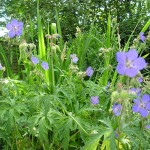
Meadow Cranesbill is gradually becoming established and puts on a fine display in summer.
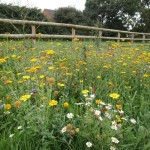
Cornfield plants flowering near the perimeter fence
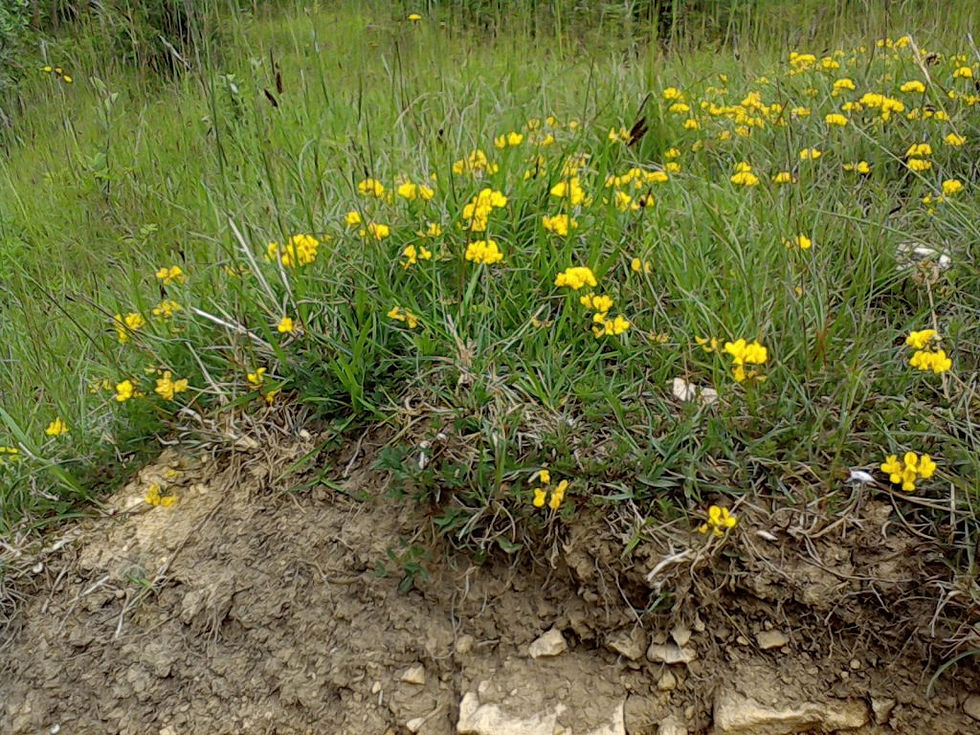
Birdsfoot Trefoil Lotus corniculatus Black Knapweed Centaurea nigra Common Sorrel Rumex acetosa Common St John`S Wort Hypericum perforatum Devils Bit Scabious Succisa pratensis Great Burnet Sanguisorba officinalis Hedge Bedstraw Galium mollugo Lady`S Bedstraw Galium verum Marsh Marigold Caltha palustris Meadow Buttercup Ranunculus acris Meadow Cranesbill Geranium pratense Meadow Vetchling Lathyrus pratensis Meadow-Sweet Filipendula ulmaria Oxeye Daisy Leucanthemum vulgare Purple Loosestrife Lythrum salicaria Ragged Robin Lychnis flos-cuculi Ribwort Plantain Plantago lanceolata Self Heal Prunella vulgaris Snake’s head frittilary Fritillaria meleagris Sneezewort Achillea ptarmica Teasel Dipsacus fullonum Tufted Vetch Vicia cracca Water Mint Mentha aquatica Wild Carrot Daucus carota Yarrow Achilla millefolium Yellow Rattle Rhinanthus minor Yellow Flag Iris Iris pseudacorus Below is a short video clip filmed in 2015 showing a beautiful stand of Meadow sweet flowering in the small channel that joins the 2 wildlife scrapes.


Comments